
Whisker Analysis
Don’t give tin whiskers a chance
Test Laboratory: Whisker Analysis
We detect, analyze, measure, and evaluate whisker growth on electronic assemblies, components, and surfaces. Tin whiskers can cause short circuits, intermittent faults, and failures—especially in safety-critical applications. Using high-resolution microscopy and SEM/EDX analysis, we identify whiskers, determine their morphology, and assess the risk to your product.
ADVANTAGES OF WHISKER ANALYSIS
Whiskers are microscopically fine, hair- or needle-shaped metal crystals. Whiskers that grow in an electrical circuit or connection point often cause electrical products to fail. We use our expertise in whisker analysis to examine your components with state-of-the-art laboratory equipment and determine the presence, length, and location of whiskers. The analysis and prevention of whisker growth are fundamental to the safety and reliability of electrical products.
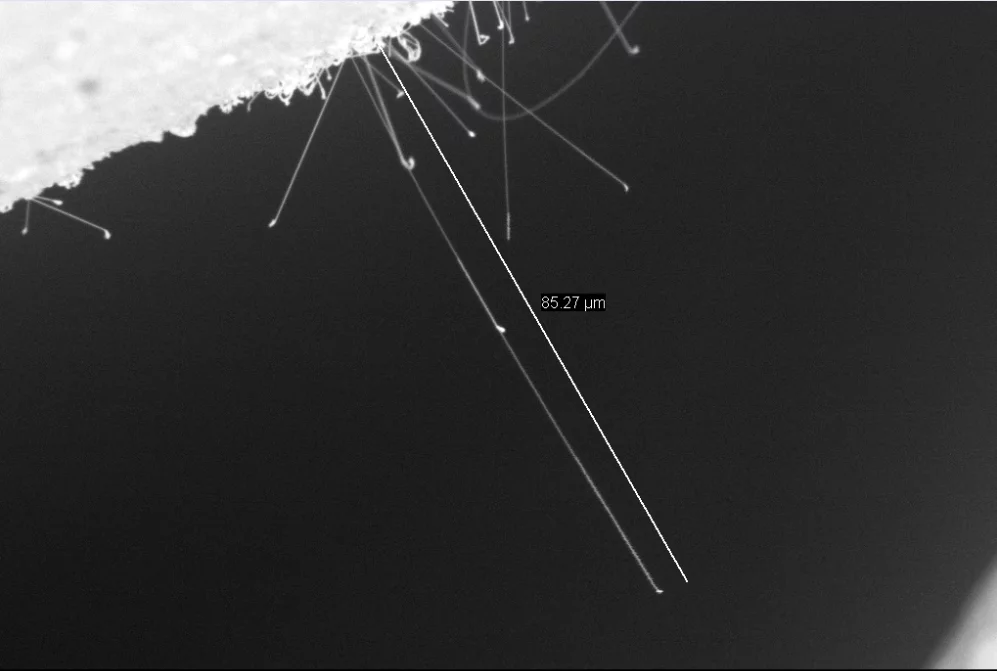
Typical use cases:
- Detection of Tin Whiskers on Surfaces and Solder Joints
- Evaluation of Whisker Growth Under Temperature, Humidity, or Vibration Stress
- Analysis of Failures Caused by Short Circuits or Intermittent Faults
- Investigation of Coatings, Surface Finishes, and Material Combinations
- Risk Assessment for Automotive, Industrial, and Medical Electronics
Scope of Services:
- Visual Inspection Using Reflected Light and Digital Microscopy
- SEM Analysis for Visualizing the Finest Whisker Structures
- EDX Elemental Analysis to Confirm Material Composition
- Measurement of length, density, and morphology; documentation of all findings with images
- Documentation
Result:
- Reliable Detection of Whiskers and Potential Risk Areas
- Assessment of Whisker Growth and Possible Failure Mechanisms
- High-resolution image documentation
- Recommendations for Reducing or Preventing Whisker Formation