Sampling & cutting technique
Testing Laboratory for Section Preparation
Your testing laboratory for specimen preparation of metals, plastics, ceramics, and electronic components. Precise cutting, grinding, and polishing processes reveal microstructures, layer structures, pores, cracks, and interfaces. Section preparation forms the basis for reliable microstructural analyses, failure analyses, and quality assessments.
At a Glance
Microsections are used to visualize microstructure, hardness, or potential material defects. By using a series of progressively finer grinding steps, both coarse structures and fine details can be revealed. This allows specific defect patterns to be identified at specific levels, enabling a precise analysis and reliable assessment of material quality. Using state-of-the-art materialographic preparation and cutting techniques, as well as high-precision testing methods, our testing laboratory ensures reproducible results.

Typical use cases:
- Representation of Microstructures, Layered Systems, and Interfaces
- Inspection for Cracks, Porosity, and Delamination
- Analysis of Solder Joints, Welds, and Contact Areas
- Preparation for SEM/EDX Analyses
- Comparison of Material Batches or Manufacturing Processes
Scope of Services:
- Precision Cutting (including diamond wire saw)
- Embedding (hot, cold, and rapid embedding)
- Multi-stage grinding and polishing
- Optional etching to expose the microstructure
- Documentation of Polishing Quality
Result:
- High-quality micrographs
- Visualization of Relevant Microstructures
- Basis for further analysis
- Assessment of material quality or the cause of damage
Sampling & Separation Technology:
Precise cuts for informative micrographs
Pre-embedding:
Before cutting, samples or sample areas can be pre-embedded to stabilize them and protect them from vibration damage, chipping or deformation, thereby also preserving sensitive structures and possible defect patterns.
- Cold mounting in various shapes for complex geometries, large samples or complete printed circuit boards, etc.
Separation process:
Selection of the cut-off wheel
- Consideration of material, hardness and specimen geometry
- Selection of the appropriate disk type, grain size and bond
Defining the separation parameters
- Adjustment of cutting speed and feed rate
- Ensure a sufficient and even supply of coolant
Carrying out the separation
- Gentle cutting to avoid cracks, chipping and thermal damage
- Guarantee of a precise and unadulterated sample cross-section
Embedding - stability for precise analysis
Warm embedding
- Process: Embedding under pressure and elevated temperature in thermosetting resin
- Advantages:
- Very stable embedding
- High edge stability
- Particularly suitable for metallic materials
- Restriction:
- Not suitable for temperature-sensitive or pre-damaged samples
Cold embedding
- Process: Embedding at room temperature with liquid synthetic resins
- Advantages:
- Gentle for temperature-sensitive materials and pre-damaged samples
- Suitable for irregularly shaped samples or delicate structures
- Possibility of adding pigments (also fluorescent)
- Applications:
- Highlighting of pores, cracks and inclusions
- Facilitates the microscopic analysis and documentation of defect images
Fine machining for clear structures - Mechanical preparation
- Procedure:
- Grinding with SiC paper in graded grit sizes up to 4000 grit
- Further processing with diamond wheels for harder materials if necessary
- Polishing process is carried out manually, depending on the type of sample with suspensions (e.g. diamond or oxide polishing)
- Advantages:
- Flexible application for different sample types
- Particularly suitable for individual samples or special shapes
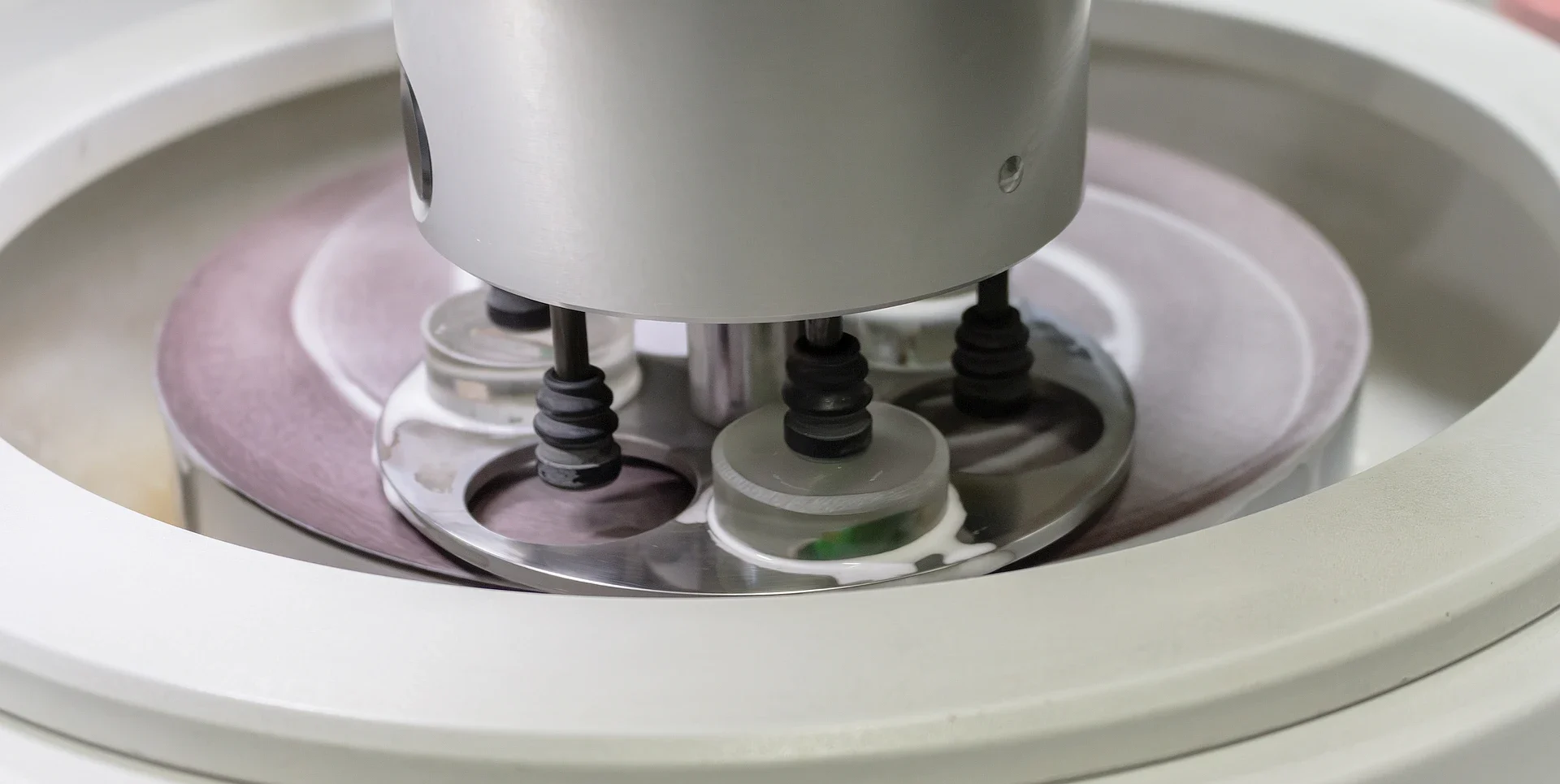
Semi-automatic preparation
- Procedure:
- Sample fixation in holders, uniform contact pressure and automated guidance
- Use of SiC paper up to 1200 grit for coarse sanding and fine sanding up to 4000 grit
- Reworking with diamond wheels for particularly hard materials (e.g. steels, hard metals)
- Standardized polishing processes:
- Metallic samples → Diamond suspensions (1-9 µm)
- Ceramic or soft samples → Oxide polish (e.g. aluminum oxide)
- Advantages:
- High reproducibility and consistent surface quality
- Reduction of sample distortion, edge chipping or uneven removal
- Efficient processing of several samples simultaneously
Etching & microstructure analysis - making structures visible
- After preparation (grinding and polishing), specimen surfaces are mirror-smooth and microstructures are not recognizable
- Differences in chemical composition or grain boundaries are made visible through etching
Chemical etching:
- Application or immersion of the sample in a suitable etchant
- Control of exposure time, temperature and concentration to avoid over- or under-etching
- Thorough rinsing and drying of the sample after etching
- Different structural components react differently to the etchant
- Grain boundaries, precipitates or secondary phases stand out in such high contrast
Examples:
- Steels: Nital (ethanol + nitric acid) to produce ferrite, pearlite or martensite
- Copper alloys: Iron-III-Chloride solutions
- Aluminum alloys: Fluoride or hydroxide-containing solutions
Geometric Features & Defect Evaluation –
Standardized Analysis for Maximum Informativeness
Macroscopic analysis:
- Viewing range: with the naked eye or under low magnification (up to approx. 25x)
- Examination of the rough microstructure and visible defects
- Typical applications:
- Detection of blowholes, cracks, pores or welding defects
- Evaluation of e.g. coarse structures or heat treatment zones
- Often as an initial overview of the sample before microscopic examination
Microscopic analysis:
- Viewing range: under light microscope or electron microscope (magnifications 50x to several 1000x)
- Objective: Investigation of the fine microstructure and individual phases
- Typical applications:
- Analysis of grain sizes, phases (e.g. ferrite, pearlite, martensite)
- Detection of precipitates, inclusions or very fine cracks
- Quantitative evaluations with image analysis
- Use: detailed assessment of material quality and functional reliability